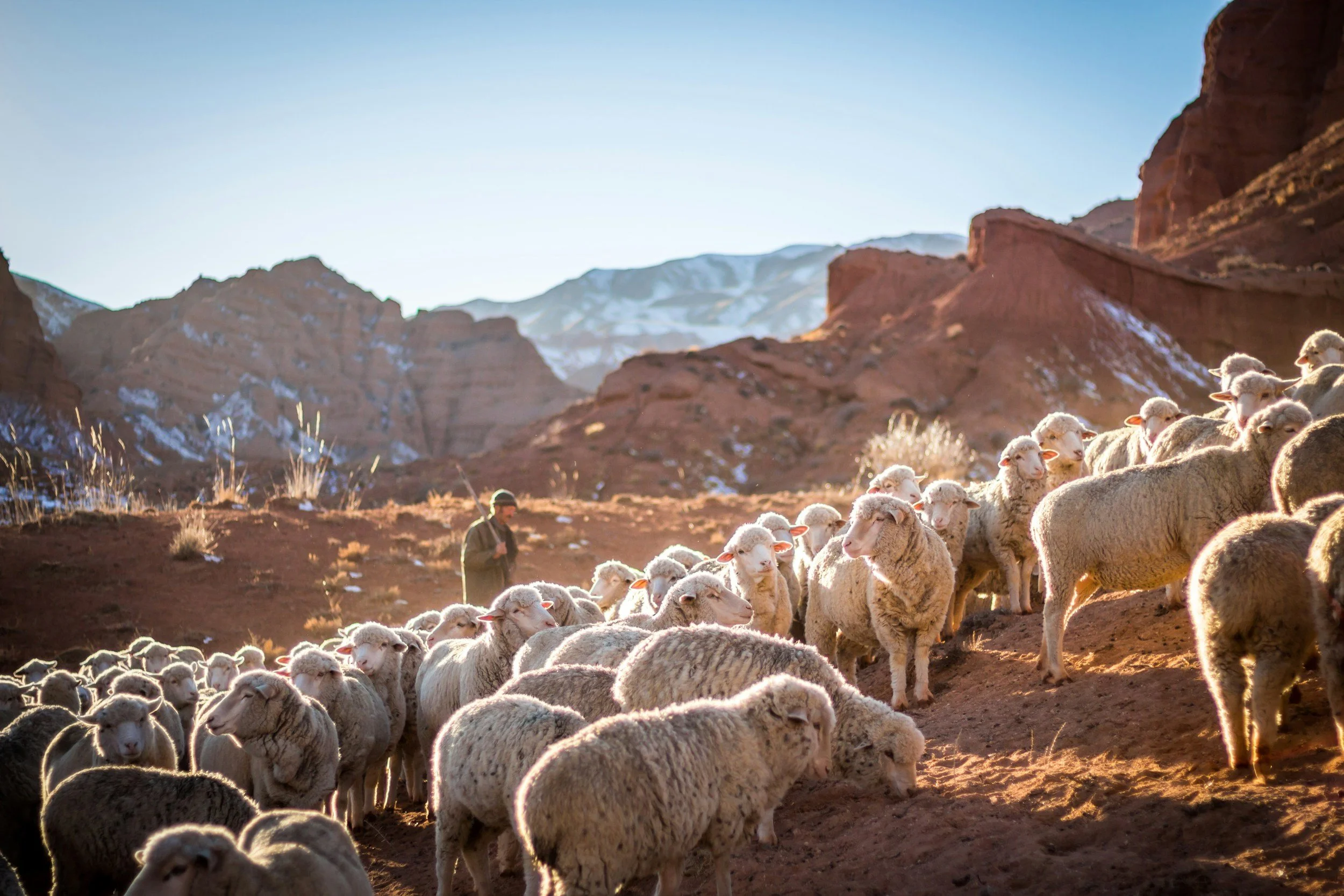
The 23rd Psalm is perhaps the most beloved of the sacred songs. Its pastoral description of God’s care for His people has comforted the hearts of God’s sheep for centuries. No doubt it has been used by God to ‘restore’ the souls of many.
The psalm carries great spiritual weight because the author, David, was himself a shepherd before he became king of Israel. He knows all about the calling and the challenges of a shepherd. His description of a shepherd’s life in this song is especially important for a culture like ours that knows little about this ancient vocation.
In David’s day, being a shepherd was truly a ‘humble occupation’, one that lay outside the mainstream of society. Yet, for the sheep, there was no occupation more vital to life itself. Shepherds and sheep had a unique relationship that rested on two binding forces; the shepherd’s great love for the sheep and the sheep’s great need for the shepherd. As to the first, shepherds were vital to the sheep’s survival in every way. Watching over helpless sheep was a full time job and shepherds had to be completely devoted to their flock in order to discharge their duty. Because sheep were defenseless, shepherds were required to be brave, often called to fight off lions and bears. Indeed the shepherd continually put his life on the line for his sheep. And in order to care for such weak creatures, shepherds had to know everything about his sheep. The shepherd must study the uniqueness of each of his sheep, being aware of their personalities, idiosyncrasies, strengths and weaknesses.
The sheep, however, were unable to contribute anything to help the shepherd. They were completely helpless and needy and they required the shepherd’s full attention simply to survive. Sheep had no natural defenses. Worse yet they were so dumb that they frequently put themselves in harm’s way without even knowing it. They wandered around the fields aimlessly which often brought them into the place of danger. They often got caught in thickets, as Jesus taught. If they happened to fall on their back they couldn’t get back up on their feet and without help would most certainly die. They didn’t even have the ability to find their own food or suitable watering places. By nature they were blind followers and if one sheep ran off a cliff the rest would follow. Added to that, sheep are very stubborn and refuse to move if pushed. All in all, there was never a moment the shepherd could rest while the sheep were out grazing. He must always be on constant vigilance for their safety.
What makes this psalm so relevant to all believers is that the relationship here described between the sheep and the shepherd was a perfect picture of the relationship of God to His people. Both in the Old and New Testaments, God is portrayed as the shepherd to His people. The final verse of Psalm 77 the entire nation of Israel is likened to a flock of sheep being led by God through Moses and Aaron. The prophet Isaiah takes note of the sheep’s propensity to wander when he describes humanity as ‘all we like sheep have gone astray.’ And of course as we come to the New Testament we find Jesus calling Himself ‘the good shepherd.’
What is generally overlooked about this psalm is the how it so clearly describes the gospel, for it describes how God, as the shepherd, is always the active agent of salvation and the One who gives all things to His people. At the same time it describes the sheep, God’s people, as a miserably helpless flock that can do nothing to earn God’s gifts but is only asked to receive the blessings conferred on them. The psalm therefore has only two main actors; God, who represents the Shepherd, and David, who represents the sheep. And here we will find eight things that they Shepherd promises to do for His people as well as three glorious realities that highlight the blessedness of the sheep.
First what does the shepherd do for the sheep? We see first a statement of fact that heads up the song. ‘The Lord is my Shepherd’. The name ‘Lord’ is the personal, covenant name of God written in English as Yahweh. Using the actual name of God reminds us that God is truly a person who establishes relationships in personal ways. So what does this personal God do for His sheep? First, the shepherd makes the sheep lie down in green pastures (vs 2). The verb in the Hebrew is in a causative form and is right to render it, ‘He makes me lie down.’ God does not merely provide a safe place for the sheep to rest, but he actually influences them to lie down because sheep can be resistant to doing anything good. God literally puts His sheep in fertile pastures. As I mentioned before, sheep cannot find their own food. Left to themselves they will eat the wrong foods and die. They are notorious junk food addicts. So the shepherd must put the sheep in pastures where they can feed healthily. Second, the shepherd leads the sheep by still (quiet) waters (vs 2). Like all animals, sheep must drink water to stay alive. But sheep are so skittish that they won’t drink from turbulent waters, or even fast running rivers. It is the shepherd’s job to find gently flowing waters where the sheep will feed in safety and comfort. Third, the shepherd restores the sheep’s soul. The word ‘restore’ means to turn back, or restore to former place. The shepherd is not only concerned for the physical health of the sheep but desires to put them in a place of total contentment. So the shepherd does for the sheep what a vacation on the beach or a walk in the park does for humans. These things calm our inner being and bring us back to a place of rest and reason. Restoration settles the heart in the midst of a chaotic world. Later on the true Shepherd will come to the sheep and promise that inner rest. ‘Come unto me all you who labor and are heavy laden and I will give you rest’ (Mt 11:28-29). Fourth we learn that the shepherd guides the sheep in ‘right’ paths (vs 3). When reading this one might think that the shepherd is responsible for the moral behavior of the sheep. But this would not make sense for sheep. Rather ‘paths of righteousness’ in the context means that the shepherd guides the sheep in the ‘best’ or ‘most appropriate’ paths possible, paths that are best for sheep given their many weaknesses. That is the shepherd is always on the lookout for paths that are not rocky or dangerous or steep or taxing. The shepherd is always scouting ahead to find the best routes for his beloved flock. Fifth, the psalm further teaches that the shepherd remains with his sheep at all times (vs 4); ‘for thou art with me.’ As an invalid often needs 24 hour care, so do sheep need the shepherd to be near them always. And even when the sheep cannot sense the shepherd’s presence they know he is always nearby and watching. So God says to His people in Hebrews 13:5 ‘I will never leave you nor forsake you.’ Sixthly, the shepherd comforts the sheep by his personal involvement (vs 4). This is represented by his use of the rod and staff. Both were long sticks, one an instrument to nudge and direct, the other as an instrument of support (as Jacob leaning on his staff). This reminds us that sheep stray very easily and often need something to poke them into line. The concept of using a rod of discipline compelled by love is foreign the world’s way of thinking but in the Lord’s flock it is the way of safety for the rod and staff prevent God’s lambs from plunging into deep trouble. The shepherd was a ‘hands on’ parent, never allowing his beloved to wander too far away. Many of us who have walked with the Lord know this truth fully. Commentator Benson says, ‘(God’s) rod of chastisement and correction also ministers to the comfort of his people, and much more his staff of support, his upholding grace, which, under all their trials, and even in their last and greatest trial, is sufficient for them.’ In the seventh place the shepherd prepares a table for the sheep in the midst of its enemies (vs 5). The shepherd bestows upon his sheep special blessings given to no one else. We call this grace. When everything seems dark and gloomy and life seems to hold no joy and when enemies surround, God sets a table for his sheep filled with delicacies. The sheep eat well even while wolves and jackals scrounge for the bare necessities. How gracious the shepherd is to the underserving sheep. And lastly the psalm tells us that the shepherd anoints the sheep with oil (vs 5). Scripture always associates oil with joy (Amos 6:6), and well it should, for in this dry and dusty environment, oil is the elixir of life that softens the sheep’s dry and brittle skin. The application of oil also denotes one’s being set apart for certain privileges, just as priests, kings and prophet were anointed with oil upon entering their vocation.
Here, then, are the eight things the shepherd freely gives to the lowly sheep, none of which depend on the sheep’s worthiness. Given all the shepherd’s gifts what will the sheep do in response? The psalmist lists three.
First, because of the sheep’s relationship to the shepherd they, shall never want (or lack) for anything (vs 1). The very psalm is headlined, ‘the Lord is my shepherd’ (and because of that) ‘THE SHEEP WILL LACK NOTHING.’ We must be careful here to understand what David means. The shepherd always gives the flock exactly what it needs but never what it desires. He alone sees the big picture and knows all that is essential to the wellbeing of the sheep. It is absolutely true that all of God’s sheep have everything necessary for ‘life and godliness.’ Second, the psalm says the sheep will never fear evil (vs 4). Because the shepherd is out front leading them, the sheep need not assume the role of taking care of themselves. Sheep were often exposed to dangerous places, narrow, dark, dangerous ravines where predators often lurked. But even in those places the sheep had no need to fear because of what the psalmist says next, for thou art with me. We are fearful when things unknown are left to chance. We grow anxious thinking about every bad thing that might happen to us. But when we are under the care of the One who knows all things and guarantees our safety, then we can relax and live in the full confidence of the shepherd’s presence. What is said lastly about the sheep is that their cup overflows. The life of sheep is likened to a banquet where more is given than can possible be enjoyed. This is always the way of the shepherd. He gives to the sheep ‘superabundantly more than they could ask or think.’ What God wants us to know is that His sheep are to live a life of constant celebration for they are always under the bountiful care of the great shepherd. What a comfort this ought to be for any lost, forlorn, backslidden, dried up, distant, or wandering lamb. God never gives up on of his little lambs; never stops pursuing them; never stops giving to them. So is the message of psalm 23.
So what does Psalm 23 intend to teach us about God, about us, and about God’s gospel? First, it clearly teaches that God’s people have more than they could possibly imagine simply by virtue of being one of His sheep. Second, we learn that the true Shepherd is not a hireling who works only for reward. Rather he is actually the owner of the sheep. How could He ever forget them? Listen to the words of Isaiah 49:15, ‘can a mother forget the baby at her breast and have no compassion on the child she has borne? Though she may forget, I will not forget you!’ The sheep are forever His. ‘My Beloved is mine and I am His’ (SOS 2:16). Third, the shepherd is ever the giver while the sheep are ever the receivers. It is the highest form of worship to honor God as the Giver, while at the same time the sheep are most honored when they willingly receive all God’s gifts. How we so often turn that around and try to find some honor in ourselves by trying to pay God back for His gifts. In doing we turn grace into debt and diminish God’s honor. As a final note, those of us in the New Covenant can apply all these principles because as believers we are sheep living under the Good Shepherd. Yes, according to John 10, Jesus is the long-awaited Good Shepherd. In contrast to this are the many bad, self-serving, distracted, and cowardly shepherds that afflict Christ’s church today. These are the hirelings whom Ezekiel talks about in the 34th chapter of his book. But whether we have lived under good shepherds or bad ones, our comfort comes in knowing that Christ alone remains our only true Shepherd. And so at the end of the day all God’s sheep can say in response is HOW BLESSED WE ARE TO BE GOD’S SHEEP – AND THAT FOREVER!
This is the teaching of Psalm 23. Amen.