PENTECOST THE SECOND GIVING OF THE LAW
Anyone who reads the Bible rightly will see that all elements of the Old Covenant are there to foreshadow the consummate event of history, the giving of the Messiah to the world for the forgiveness of sins. All other history, including that of the Old Testament, is but a handmaiden to serve the great events of the death, burial and resurrection of Jesus Christ. It ought not surprise anyone that the Old Testament Jewish feasts are far more than celebrations by an ancient culture. They are, rather, pictures of the full redemptive plan of God in Christ. In this post we will look at the relationship between the feasts of Passover and Pentecost and that when we put these two feasts together we will see a comprehensive picture of God’s salvation of sinners, both their justification and sanctification.
The Passover outlined in Exodus chapter 12, is clearly a type of God’s initial work of salvation to forgive sinners based on the work of Jesus Christ on the cross. The Baptist explicitly noted that Jesus was “the lamb of God who takes away the sin of the world.” That Lamb was most likely the lamb slain during the Day of Atonement in Leviticus chapter 16. The plethora of additional Old Testament sacrifices under the law are a further proof that the forgiveness of sins comes by the substitutionary death of a slain animal. Going all the way back to the beginning we find that Adam and Eve were covered by an animal skin. The shedding of blood is the way God saves, “for without the shedding of blood there is no remission.” But not all shed blood saves. The blood sacrifices in the Old Testament merely pointed forward to that one great sacrifice on the Hill Calvary. And it is that one sacrifice that “perfects forever those who are sanctified.” Apart from the blood sacrifice of Jesus Christ, there is no more sacrifice for sin. Christ’s work on the cross alone is the event that actually forgives sin. And just as the Jews of old were rescued from the Angel of Death by remaining in their homes under the blood sprinkled on the wooden doorposts, so too, all believers are saved by standing underneath the blood-soaked wooden cross of Jesus Christ.
But forgiveness of sins is only a part of the salvation wrought by God on behalf of sinners. Passover and Calvary are judicial acts whereby sinners are reckoned righteous before God. Blood covers sin but does not change the sinner. Passover paid Israel’s legal debt to God but did not change the Israelites. And Calvary pays the legal debt owed by every sinner to God but does not change their heart. Passover and the Cross are legal acts and both render those who stand under them guiltless before God. But something more must happen for the moral nature to change. So what will God do about the enmity that still exists between a holy divine nature and a forgiven yet rebellious-sinful nature? The second work of salvation, therefore, is when God takes the innocent sinner and begins to change his heart so that he will gladly perform the will of God. This is what the Feast of Weeks or the Feast of Harvest is all about. In the New Testament it is called Pentecost, an event that occurs fifty days after Passover. So while Passover is about making the sinner innocent, Pentecost is about making the sinner like God.
Truly Pentecost plays several roles in the redemptive story. Being one of the harvest festivals, it most certainly points to the ingathering of the church which occurred in history when the Spirit of God filled the disciples on that very day as outlined in Acts chapter 2. That it occurs a mere fifty days after Passover, shows there is a clear link between the blood sacrifice (the cross) and the ingathering of the church. When Christ died and rose again after three days He was inaugurating the new creation (see 1 Cor 15:23) and a mere seven weeks of Sabbaths later He began the work of making that New Creation a reality. This, according to the Abrahamic promise, would be a blessing bestowed on all the nations. Before Peter stood a crowd of Jews that day, Gentile proselytes and God fearers, including Parthians, Medes, and Elamites. One of the great messages of Pentecost was that all humanity would come together under one Lord in this New Creation. Indeed, in Abraham, “all the nations of the earth would be blessed.” We get a hint of this union by looking at the description of Pentecost in the Old Testament. In Leviticus 23:17 we note a subtle but important point,
“You shall bring from your dwellings two wave loaves of two-tenths of an ephah. They shall be of fine flour; they shall be baked with leaven. They are the first fruits to the LORD.”
Two loaves of unleavened bread are to be offered together at this feast. This is unique. Does it not foreshadow the coming together of Jew and Gentile who are here pictured as leavened bread? Search the scripture and find any other feast that uses leavened bread. The picture here is clear; God at this feast is bringing together two sinful peoples who will worship the same saving God. The unity of Jew and Gentile was not based on anything good in them but in God’s sovereign grace which comes freely to all men and unites humanity just as He promised. This what Paul was thinking when he wrote these words,
“For He Himself is our peace, who has made both one, and has broken down the middle wall of separation, having abolished in His flesh the enmity, that is, the law of commandments contained in ordinances, so as to create in Himself one new man from the two, thus making peace, and that He might reconcile them both to God in one body through the cross, thereby putting to death the enmity. And He came and preached peace to you who were afar off and to those who were near. For through Him we both have access by one Spirit to the Father” (Eph 2:14-18).
The feast of Pentecost was the promise that God would fulfill His promise to Abraham by saving all the nations through a common Messiah. God would tear down the wall ‘of commandments’ that separated the Jew from the Gentile by the coming of the Spirit. In doing this, God was reversing the curse of Babel. In man’s wisdom and his sinful bias, the nations separate. In God’s wisdom and His love for all humanity, He brings the race back together in Jesus Christ the Lord.
There is another truth that is pictured in this great feast. It celebrates the giving of the law. This is not readily apparent until we do a little biblical spadework. The question to ask is what event happened on the fiftieth day after the initial Passover? We know from Exodus the Passover happened on the fourteenth day of Abib which God then becomes the first month of the year (Ex 12:2; 6; Deut 16:1). After that, the Israelites arrive a Sinai in the third month (Ex 19:1). This means after the Passover, Israel wandered in the wilderness for fifteen days in the first month, another 30 in the second month and a day in the third month. That brings us to about 46 days. Then it adds in Exodus 19:14, that Moses took a quick trip up the mount, about a day, and then told the people that they should be ready for a visitation from the Lord on the 3rd day after that (see 19:16). Only then does Moses come down from the mount proclaiming the Ten Commandments (19:25). This was the first time the law was given. And when we add up these dates we find that the first giving of the law came fifty days after Passover.
Why is this important?
First, it is further evidence that everything God did in the Old Covenant was pointing forward to New Covenant realities. Even the very feasts of Israel proclaim the gospel of the coming Messiah. God is in control of history, and in God’s mind history is the canvas upon which He draws the full redemptive plan.
Second, it shows us that the New Covenant inaugurated by Jesus is not a covenant of anti-law, but one in which the law is honored in ways that the Old Covenant could never imagine. This causes us to consider what really happened on the Day of Pentecost when Peter preached to that crowd. Many would simply say it was the coming of the Spirit to inaugurate the church age and to bequeath to the church the power to fulfill her commission. This would be entirely right. The prophet Joel said,
“And it shall come to pass afterward, that I will pour out my spirit upon all flesh; and your sons and your daughters shall prophesy, your old men shall dream dreams, your young men shall see visions” (2:28).
But as we look further at some other prophetic writings we find there is something else going on here. And many miss this. If we look at the New Covenant promises in Jeremiah and Ezekiel we come to discover this additional truth. We look first at this well-known text from Jeremiah,
“Behold, the days come, says the LORD, that I will make a new covenant with the house of Israel, and with the house of Judah: not according to the covenant that I made with their fathers in the day that I took them by the hand to bring them out of the land of Egypt; which my covenant they brake, although I was an husband unto them, says the LORD: But this shall be the covenant that I will make with the house of Israel; After those days, saith the LORD, I will put my law in their inward parts, and write it in their hearts; and will be their God, and they shall be my people. And they shall teach no more every man his neighbor, and every man his brother, saying, Know the LORD: for they shall all know me, from the least of them unto the greatest of them, says the LORD: for I will forgive their iniquity, and I will remember their sin no more” (Jer 31:31-34).
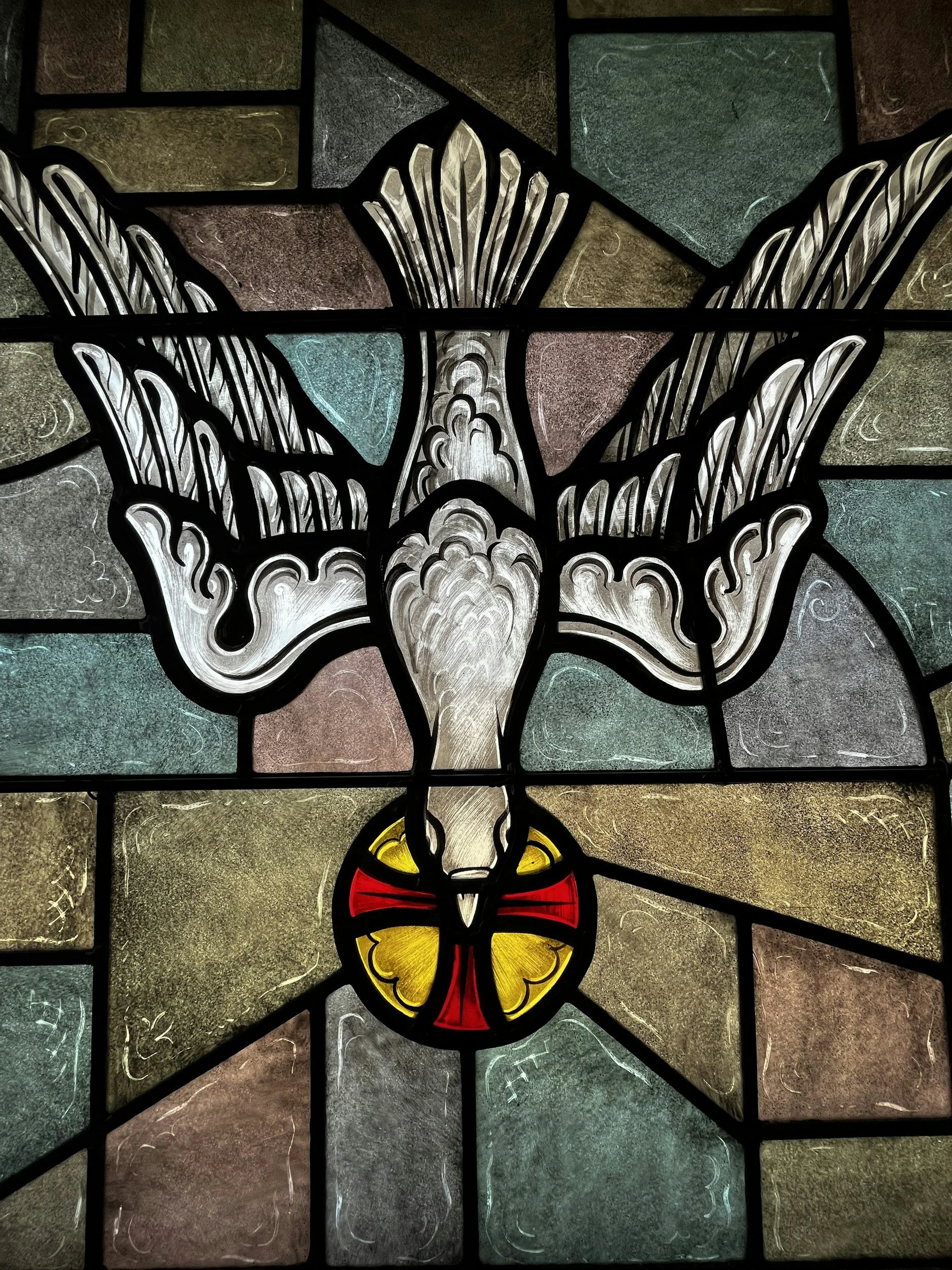
It is clear that the great advancement of the New Covenant over the Old, is that the law of God does not come to the people of God on stone plates which are external to man and impossible to obey, but the law is now inscribed directly on the heart every believer. In the Old Covenant, Pentecost saw a prophet proclaiming the law to a frightened people amid fire, thunder, lightening, and threatening voice. But now in the New Covenant the law is given amid fire of another kind, that of a gentle dove, who comes not to threaten people to keep the law, but by giving them the ability to keep it. Notice how clearly Jeremiah puts this. “I will put my law in their inward parts.” The difference between the first Pentecost in Exodus and the Pentecost in Acts is far as east is from the west. Both herald the giving of the law, but one comes with a legal frown, the other with a smile of grace.
“But Jeremiah says nothing of the Spirit,” one might object.
So we turn now to Ezekiel, a contemporary prophet, who, like Jeremiah, was looking forward to that day when the people of God would be restored fully and obey God willingly. It is important to note that neither prophecy makes sense if it refers to national Israel. The prophets may have thought God would restore the nation, but, in fact, God was using them to show forth a far more glorious event that may have exceeded their comprehension. And that event was the giving of the Spirit which coincided with a second giving of the law during the gospel age. Ezekiel says,
“Therefore say to the house of Israel, ‘Thus says the Lord God: “I do not do this for your sake, O house of Israel, but for My holy name’s sake, which you have profaned among the nations wherever you went. And I will sanctify My great name, which has been profaned among the nations, which you have profaned in their midst; and the nations shall know that I am the Lord,” says the Lord God, “when I am hallowed in you before their eyes. For I will take you from among the nations, gather you out of all countries, and bring you into your own land. Then I will sprinkle clean water on you, and you shall be clean; I will cleanse you from all your filthiness and from all your idols. I will give you a new heart and put a new spirit within you; I will take the heart of stone out of your flesh and give you a heart of flesh. I will put My Spirit within you and cause you to walk in My statutes, and you will keep My judgments and do them. Then you shall dwell in the land that I gave to your fathers; you shall be My people, and I will be your God’” (Ezek 36:22-28).
Ezekiel speaks of the same event that Jeremiah speaks of only here he includes the imparting of the Spirit of God within the believers. In other words, according to this prophet, the coming of the Spirit of God is connected to the giving of the law into the hearts of mankind. It is parallel to the Pentecost of the Old Covenant. And what is the result of this new giving of the law? The New Covenant saints do not simply receive the law but will be given the ability to obey it in ways that David, Abraham and Isaiah, never could. On several occasions Jesus notes this aspect of the Spirit’s coming,
“But the Helper, the Holy Spirit, whom the Father will send in my name, he will teach you all things” John 14:26.
And,
“When the Spirit of truth comes, he will guide you into all the truth.” John 16:13.
According to Jesus, the Spirit comes to teach and guide the saints. How? By ecstatic experiences or feelings? No, by causing New Covenant believers to know, understand and obey the truth. The Spirit has not come down from Sinai to show us what we cannot do, but comes down from heaven to enable us to obey in ways that were previously impossible.
Paul too makes explicit reference to the superiority of Spirit’s coming to the hearts of man as opposed to the old giving of the law. In 2 Cor 3:3, he says, “Clearly you are an epistle of Christ, ministered by us, written not with ink but by the Spirit of the living God, not on tablets of stone but on tablets of flesh, that is, of the heart.”
The second coming of the law at Pentecost brings the law to God’s people in a way that is both delightful and attainable. Now we see the connection between the feasts. Passover is the feast of redemption of God’s people to negate the penalty of sin; Pentecost is the re-giving of the law in such a way that God’s people will now be able to defeat the power of sin. In the first Pentecost, Israel’s salvation is stilted because they are redeemed but not made holy. But in the New Covenant, salvation is now complete. God’s people are redeemed AND made obedient. Yes, New Covenant believers are enabled to do what the tablets of stone could never do. To say that the people of God are now ‘filled with the Spirit’ is no hyperbole. Rather it is a guarantee that all His people will one day become perfect law keepers because the Spirit will finish the work He began.
The implications of this truth are staggering. I will suggest a few but leave it to the readers to meditate on this astounding truth in their own time.
First, my dear believer, do you see how safe you are as a Christian? God has given you His Spirit and that is God’s guarantee that you will one day become perfectly conformed to His will and enjoy Him forever. And know this, no matter how shaky your faith, or how fierce your struggles against God, or how frequently you entertain lingering doubts, God will not fail in His endeavor to save you. What God begins, He will most certainly finish. Passover is the basis upon which God forgives you, Pentecost is the promise that He will bring grant you a full fellowship with Him as he unites your heart to His in holy obedience. Pentecost assures you of this great truth.
Second, this verse tells us that the law of God is not unimportant. Many accuse those, like myself, of hating the law because we teach that the believer is no longer under its curse and that we are free of its condemning power. Yet Pentecost teaches us that conformity to the law is the ultimate goal of God’s salvation. He saved us to make us like His Son and in order to be like His Son we must be a people who freely embrace and obey the will of God. And what is that law that God writes upon our hearts? It is the law of loving God with everything we have and loving our neighbor as ourselves. That means the law etched into the fabric of every believer’s soul is the law of loving God and neighbor. Seeing it this way, we can exclude laws given in the Old Covenant that are national or cultural by nature and have nothing to do with loving God and neighbor. Paul says it this way,
“Owe no one anything except to love one another, for he who loves another has fulfilled the law. For the commandments, “You shall not commit adultery,” “You shall not murder,” “You shall not steal,” “You shall not bear false witness,” “You shall not covet,” and if there is any other commandment, are all summed up in this saying, namely, “You shall love your neighbor as yourself.” Love does no harm to a neighbor; therefore love is the fulfillment of the law” (Romans 13:8-10)
The promise of Pentecost is that he who trusts in Jesus Christ is given the Spirit who inscribes on the heart the law of love. Conclusion? You who are a believer in Jesus are in the process of learning to love God and neighbor. The process is slow, but it cannot fail. Cling to the promise of Pentecost every day. God is working in you mightily. He can do none other. Celebrate the feast knowing that one day you shall be singing with the mighty angels before the throne of God, loving your God with all that is in you, and loving your neighbor perfectly with a heart that is full and free.