WHY LUTHER?
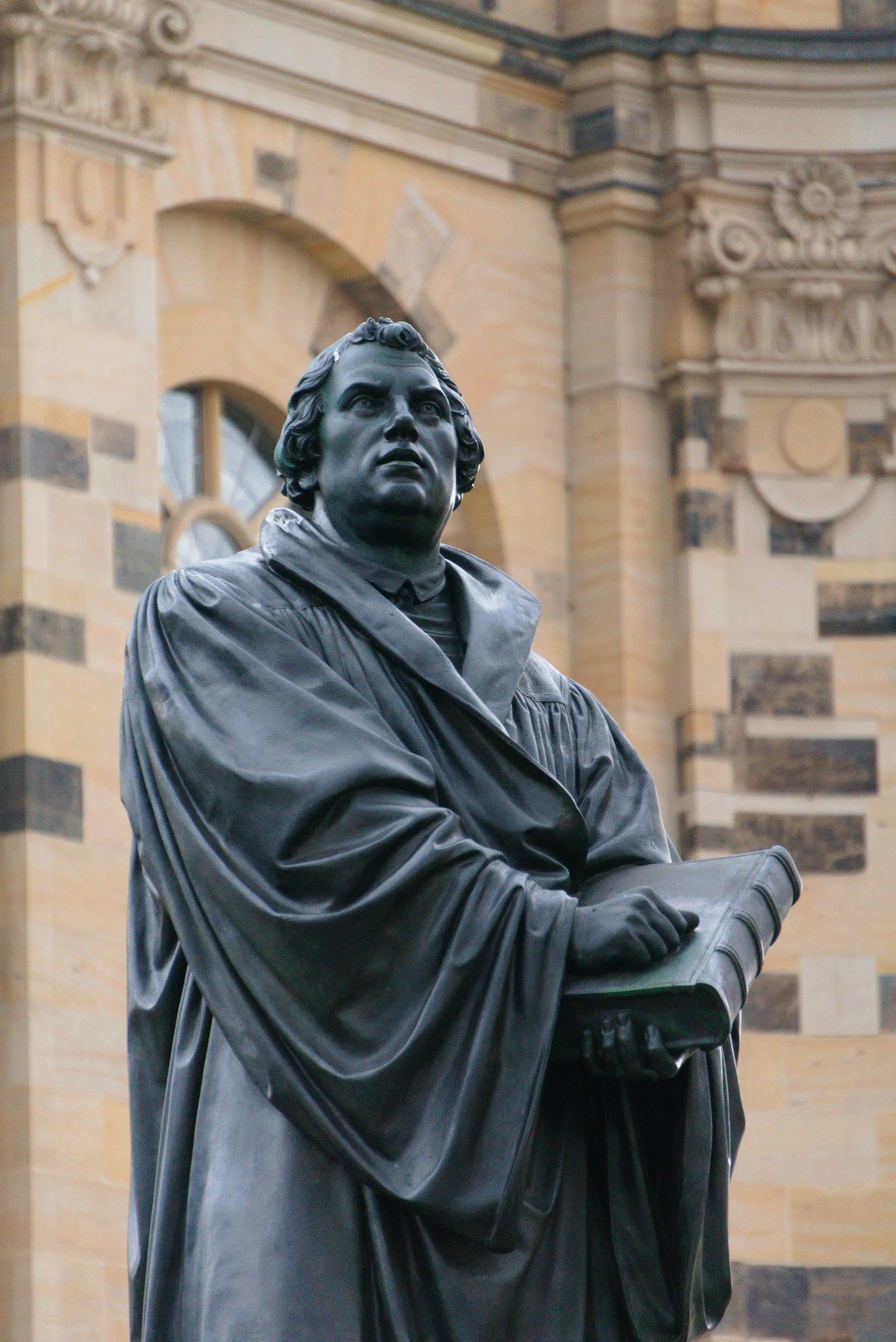
I have often sat in my chair and wondered why God uses anybody for His purposes. God needs no one. That He condescends to use anyone is a testimony to His grace. Nothing more, nothing less. To be sure, God often uses some very broken vessels which leaves us scratching our heads. Perhaps this is no more true than in the life of Martin Luther. The German monk turned Reformer certainly wasn’t used because of any high attainment of moral impeccability. He was a sinner and his faults lie clearly on the surface. He spoke with an acerbic tongue, could be demeaning, impetuous, and boorish and he indirectly caused the death of many peasants in Germany. Additionally, later in life he developed a deep aversion to Jews. Not exactly a resume we would seek were we looking for someone to reform the church. But God used Luther… mightily. So why would God use this man? We know that God works outside our predictive wisdom and no man can actually discern His reasons for doing anything. Notwithstanding, God often uses men who have recaptured biblical truths that are vital to the building of His kingdom. God may not be bound to use men, but He always uses His word. I believe this is the key to understanding why God used Martin Luther. This article will attempt to explain why.
Martin Luther, born in 1483, was born to a low-middle class family, the son of a coalminer, who found himself, by a series of providential strokes, leading the opposition to a powerful medieval church. When one studies the life of this man, one is struck by one overriding character trait. Luther was a man that took his sin and the holiness of God seriously. He could be very emotional, seemingly unstable. At times he exhibited strange behavior, like throwing an inkwell at the devil, or confessing his sins for hours to a priest or shamefully freezing up when he was performing his first Mass. Had he lived in our therapeutic culture today he would have been labeled with a developmental disorder and cast aside as a sick man. Fortunately for us, the sixteenth century was not saturated in Freudian psychoanalysis where all behavior is linked to subliminal wounds. That Luther was sensitive, perhaps overly sensitive, cannot be denied. As we review his life, however, we come to see that through this sensitivity to sin and the heavy burdens of guilt he carried, Luther was driven to discover some important truths that had long been forgotten. Through them God made him the leader of the greatest Christian restoration movement the world has ever known. We call it the Reformation.
Three theological concepts that Luther rediscovered form the backbone of this article. They are: the hermeneutical principle of law and gospel, the theological principle of the theology of the cross, and the experiential principle of simul justus et peccator. The three combined give us a comprehensive understanding of Martin Luther and how together they form a solid foundational construct upon which to build one’s life of faith. These insights did not come without a cost. For them Luther was opposed, ridiculed and eventually excommunicated. These concepts threatened the existing order and were certainly viewed as radical. This makes Luther a radical as well. Yet over five hundred years later there are millions of Christians who have been freed by Luther’s ‘radical’ teachings and are now living in the noonday light of these wonderful truths.
The first concept to discuss is Luther’s hermeneutical principle of law and gospel. This hermeneutical principle provided Luther a framework by which to understand the Holy Scriptures. What it says, in essence, is that God reveals himself to man in only two ways, through law and through gospel. The law is God’s perfect will communicated to man externally through commands and internally through the conscience. The law is always perfect because God is perfect. It never relaxes its demand; it only tells men what they ought to do and must do. God’s law never settles for anything less than perfect obedience. Not surprisingly law is always frightening to fallen humanity. We see the law operative in the very first chapters of the Bible. In the Garden of Eden God gave a command, “Of the tree of the knowledge of good and evil you may not eat for in the day you eat thereof you shall surely die.” Adam heard that command and agreed with God. Adam had no trouble understanding God. Law always makes sense to mankind because law is part of human nature; we are born understanding right from wrong. But alas, in the eating of the forbidden tree, Adam lost his innocence and passed on to his progeny the inclination to disobey. Ever since then mankind both knows law and disobeys it. Man, through Adam, now possesses a nature that is inclined to disobey God. We call that the sin nature. The result of this fall was that Adam hid from the God with whom he once walked in the garden. Feeling his shame, Adam covered himself with fig leaves. This was an external ‘fix’ for a deeply internal problem. Men have been trying to fix themselves ever since usually through the efforts of religion. But the problem is man cannot fix his anti-law nature. He is a hopeless rebel. Thus, when God commands man to do something, man is put in the position of trying to do something he can’t. Every effort to try to keep the law always leads man down a long dead-end street that ends with a punishing wall.
But man never stops trying to do what he can’t do. One of the ways man tries to get around this wall is to imagine that it is lower than it really is. The monks of the medieval world, of which Luther was a part, believed this. Enough self-denial, enough cleansing the mind of worldly thoughts, enough meditation and prayer, should be good enough to bring a soul into favor with God. Luther tried this solution, lustily. But it gave him no peace. All his efforts came crashing down one day when his overly sensitive conscience happened on the words in Deuteronomy 27:26, “Cursed is the one who does not confirm all the words of this law by observing them.” The idea that partial or intentional obedience was good enough was immediately dismantled. Luther realized that all the commands of Scripture were not only just and good but also unattainable. Not even the best religious practices could get over that wall. All Bible passages that gave commands were therefore not man’s friend, but his enemy. Luther came to understand that even the attempts to keep the law by the power of the Holy Spirit fell short of perfection. No work that Luther did could ever be relied upon as righteousness before God. This belief was firmly in Luther’s mind by the time he attended the Heidelberg Disputation of 1518. There, at the general meeting of his Augustinian Order, Luther offered twenty eight propositions that centered around some new ideas, including that of the role of law. His words were fresh, insightful, and scary. Many monks were speechless and stunned by his words. Luther said, “The law of God, which is the most beneficial doctrine of life, is not able to advance man toward righteousness but rather stands against him.” Who else would say such a thing! But Luther was acknowledging two things. The law is the most wonderful thing mankind has for it shows us God’s beautiful character. And this beautiful law was unable to give men the righteousness it extolled. What was intended for good had become something that stood against the welfare of all humanity. In Luther’s mind this was one of the great paradoxes of the Christian faith. No doubt Luther understood Paul’s statement, “And the commandment, which was to bring life, I found to bring death.”
Dwelling in a universe totally foreign to law is grace. Grace is best understood as a completely free act of giving. No law defines it; no inner sense of justice drives it; no characteristic in the object woos it; no merit motivates it. It is a free act of free God. The gospel is not contrary to law. It just simply has no common features with it. Law is rooted in duty, justice, compunction, wisdom, pragmatism and a host of other manmade disciplines. It saturates the human condition with the human impulses of should, would, must, and ought. Gospel is not anti-law; it is non-law, just as musical notes are non-color. In the gospel God gives “without money and without price” simply because it is His nature to do so. This free and delicious activity of God is strewn throughout the Bible, Old Testament and New. But who can understand this divine concept? The greatest act of grace God ever did remains the most misunderstood act of all time. God bereaved Himself of His precious Son to pay the penalty for man’s vile and purposeful rebellion against Him. This greatest of all events in history is “past finding out.” Luther admitted that the gospel was mystery. He loved mystery. He believed that if the gospel made sense to anyone it could no longer be gospel but probably law. Man understands law. As to gospel man is only asked to believe it.
There are two more important points that need to be understood about law and gospel. First, law will always be law. It was law before the Fall of Adam; it is still the same law since the Fall of Adam. Jesus said in Mt 5:18, “For assuredly, I say to you, till heaven and earth pass away, one jot or one tittle will by no means pass from the law till all is fulfilled.” There is nothing in the Bible that hints that law is relaxed, even when one is adopted into the family of God. The children are still required to keep the law. Second, any idea that the law can be kept to the satisfaction of God is pure fantasy. The Bible makes it clear that all men are born with a sin nature and on top of that they continually sin and “fall short of the glory of God.” There is no difference between an idolatrous nation and a nice Christian grandma. Everyone is a lawbreaker and deserving of eternal death. A law/gospel hermeneutic, therefore, sees any biblical command to be bad news no matter who receives it. This silly evangelical notion that Christians can obey the commands of the New Testament apostles needs to be abandoned post haste. Whatever Paul, Peter or James command Christians are supposed to do. The problem is we can’t do them. This doesn’t mean that a Christians shouldn’t apply every spiritual means possible to obey the law. But because they have an active sin nature abiding within, the law can never be perfectly obeyed. Rather it can only point out our shortcomings. Paul said, “For by the law is the knowledge of sin.” That’s all the law can do. No, there is one more thing it can do. It can help chase seeking souls to the real attainment of righteousness, the grace bestowed by God in Jesus Christ.
So what is this grace of God? The gospel, according to Luther, was any promise of God that did not include man. The gospel therefore is any verse that speaks of what God has done for man without man’s participation. Thus, the gospel really has nothing to do with man, not his ingenuity, not his willpower, not his intentions, not his religious exercises, not his wisdom. The gospel is what God gives us without money and without price. He promises us the unbelievable and we are to believe it. He gives what we can’t possibly understand and we are to receive it.
What does that mean for law? Is it something bad? Not at all. Like John the Baptist pointing to Jesus, the law is that which points forward to the gospel. And so, according to Luther, the primary use of the law was to point, yes, even drive men to gospel. Gospel is God’s free gift to humanity which brings righteousness and forgiveness of sins in Jesus Christ.
The Bible is then comprised of these two opposing forces that actually work together. The law drives men to despair and to ask “what must we do to be saved?” The gospel comes swooping in to freely give men the very thing that that cannot be attained through the law. This law and gospel dynamic was how Luther viewed the Bible. The bottom line was simple: any theological construct that doesn’t divide God’s revelation between law and gospel need be abandoned.
How is this relevant today? When the law/gospel distinction is properly applied in Bible reading it prevents men from making two egregious errors. First, it prevents men from trying to lower the standards of the law in order feel better about their so-called obedience. Second, it keeps men of tender consciences from falling in despair by showing them that even though they have violated the law time and time again, God nevertheless offers them the free gift of Christ every day. In other words, a law and gospel distinction enables the saints to live in the reality of who they really are: sinners in practice, forgiven sinners in grace. And it keeps men from dying under the constant legal threats that resound from books and pulpits across America. And it keeps men from thinking they are pretty good guys for trying to obey the law in their sincerity. Quite frankly the law and gospel paradigm resurrected by Luther allows us to live lives that are truly sinful and truly forgiven, which is an exact mirror of reality.
This leads to a second theological principle discovered by Luther which is closely connected to law and gospel. It is the distinction between the theology of the cross and the theology of glory. What did Luther mean by these two concepts? Luther first made this distinction during the aforementioned Heidelberg Disputation of 1518. At the yearly meeting of his Augustinian Order, Luther, who was becoming well known, presented 28 points of theology for debate called disputations. By this time Luther’s theology was beginning to mature since the posting of his famed Ninety Five Theses. He was beginning to see the radical theological difference between the teaching of the Medieval Church and that of the Bible and some of the church fathers, especially Saint Augustine. In these disputations, we see his developing ideas about the use of the law in salvation and the doctrine of free will. More importantly, perhaps, we see Luther suggesting a distinction between two overarching theologies. One he called the theology of the cross, the other, the theology of glory. Reading his comments about the theology of the cross and theology of glory can be a rather difficult task for the modern reader as his arguments are quite foreign to the way we think today. But Luther always had this problem, even to his contemporaries. He was a man who quickly saw the nuances of Scripture and others often missed what he was trying to say. But laboring to understand Luther on this matter - or any matter - is well worth the effort, and will yield an abundant harvest of biblical understanding.
So how did Luther define the theology of glory? Here it is best to simply quote him. He describes the theology of glory this way; “He who does not know Christ does not know God hidden in suffering. Therefore he prefers works to suffering, glory to the cross, strength to weakness, wisdom to folly, and, in general, good to evil” (Luther’s comments on Heidelberg Disputation #21). He goes on to say, those who live by the theology of glory…”hate the cross and suffering and love works and the glory of works.” Luther said all this against the backdrop of a medieval religious culture that was saturated by a merit- based salvation and a theological system that overlooked the the real significance of the cross as the great demonstration of God’s wisdom in weakness and seeming failure. Luther believed the central event that illustrated the way God works in general. That is to say, God always comes to man in weakness and always does what is counterintuitive, as so many of the parables demonstrate. In God’s kingdom the weak are strong, the last are first, and defeat is the way to victory. On the other hand the theology of glory accomplished things through human ingenuity, power and determination. This theology permeated so much of Christianity in the Middle Ages. The entire scheme of sanctification with its emphasis on works, ecclesiastical obedience, and sacramental devotion was exactly the way, according to Luther, that God did not work. Using First Corinthians chapter one as his text, Luther’s main point at Heidelberg was that a theology of glory rested on the triple legs of human wisdom, feelings and willpower, In other words any theology that began with man solution rather than God’s was most likely a serious error. The cross being God’s most important work happened apart from human contribution. Man would have never come up with this plan. The proof is that when Christ came into the world they did not recognize Him as the Lord of glory. What God, said the world, would suffer shame and be publicly ridiculed by those He created. The cross flipped all theology on its head and denounced the way of human initiative. For that reason Luther’s new paradigm would be vehemently rejected by the church of his day.
Another place where medieval church had the wrong conception of God was in its understanding of love. The wisdom of man would never see God’s love exemplified in a bloody cross. Yet that is what the Bible teaches. Luther pointed out that natural man only understands love by the way man loves, which is exactly opposite of the way God loves. To man, the cross actually looks more like hatred than love. The Bible counters this notion. “Herein is love,” says John, “not that we loved God but that He loved us and gave His Son to be the propitiation of our sins.” God’s love is manifested by crushing His Son. Thus, the only way to understand God’s love is by believing God through the pain, agony, and confusion of the cross. So the theology of the cross shows us a wholly different God than what we might otherwise expect. It recognizes that God comes to us in weak and sometimes revolting ways. But man rejects that narrative and tries to find a God who comes in the wind and the earthquake and not in the still small voice. That, to Luther, was the theology of glory. Luther’s conclusion was that only a theology of the cross sees God for who He is. As to the theology of glory, it actually sees things the opposite of what they really are. Luther said it this way, “A theology of glory calls evil good and good evil. A theology of the cross calls the thing what it actually is” (Disputation #21).
On the practical side Luther taught that what is necessary to see things through the theology of the cross is humility. Humility to Luther was not acting in a self-deprecating or groveling way, but the admission that one knows nothing about God apart from God’s initiative. The theology of the cross humbly accepts truth the way God defines it, and it takes both God and humanity the way they are. Only in believing these things can man begin to see God work. The medieval church was built on glory. Man’s religious quest for God was grandiose and colorful, riddled with philosophy and supremely confident. We have same situation in the prosperous west today. How difficult is it for a confident Christian westerner to see God through suffering and failure when he sees Christianity in a wholly different light. To get a Christian to see God this way is as difficult as convincing a blind man to behold the beauty of the Mona Lisa. In fact, if you analyzed most evangelical churches today - even churches with a Reformation heritage — you will find the main theological paradigm that governs everything is a theology of glory: man’s initiatives, man’s programs, man’s wisdom, man’s disciplines, man’s excitement, man’s flamboyancy. Luther and the theology of the cross has a lot to teach us.
A third theological concept made popular by Luther was contained in the Latin phrase simul justus et peccator which means at the same time just and sinner. This concept helps explain how the Christian should view his own standing before God as he lives out his Christian life. No doubt Luther’s idea was born out of his own experience. As a monk, Luther was a man with an extremely tender conscience. He realized the pervasive nature of sin in his life and spent hours repenting before his priest. Once Luther came to understand the evangelical doctrine of justification by faith he began to slowly understand how he could thrive under a perpetual status of innocence before God even though he sinned daily. He was a saint while still being a sinner. Both identities were true and both managed to exist side by side in his experience under the uniting power of the cross. As to his legal standing before God, he was always innocent and beloved by God and standing upon the substitutionary death of Christ. At the same time he was as a man still living under the curse who sinned daily and must often repent. Luther saw this as the paradoxical mystery of the Christian life. This understanding became the backbone of Luther’s view of the Christian life. On the one hand the Christian man is ever a slave to his sin. On the other hand the Christian man is ever the free man in Christ, free to love and serve. This teaching drove Luther away from an inordinate focus on his own heart. He could now serve God knowing that nothing he did was perfect, while also knowing that he was personally pleasing to God. This mystery enabled Luther to survive emotionally and spiritually. It made Luther a man both of confidence and humility, which made him a most useful vessel.
Why did God use this very flawed man to spearhead the Reformation? That was my initial question. Many answers could be given. This article has tried to show that Luther was used by God not because of his sterling piety but because he uncovered important truths long buried beneath the rubble of medieval tradition. Specifically, he uncovered the correct biblical interpretive principle of law and gospel. Second, he uncovered the lens through which all theology must be seen, namely a theology of the cross. And thirdly, he gave to the church the right way for believers to view their paradoxical lives as both saints and sinners. Luther brought simplicity to Christian living that was not seen in the complex and esoteric medieval system. We live in an age where medieval practices, though called by different names, are legion. Perhaps a true restoration of the church will come when some of Luther’s ideals come upon us in mighty power. For this we can only hope. Amen.